
Resurrecting Ancient Cannabis: How Scientists Brought 25-Million-Year-Old Enzymes Back to Life
New research reveals the evolutionary origins of THC, CBD, and CBC production
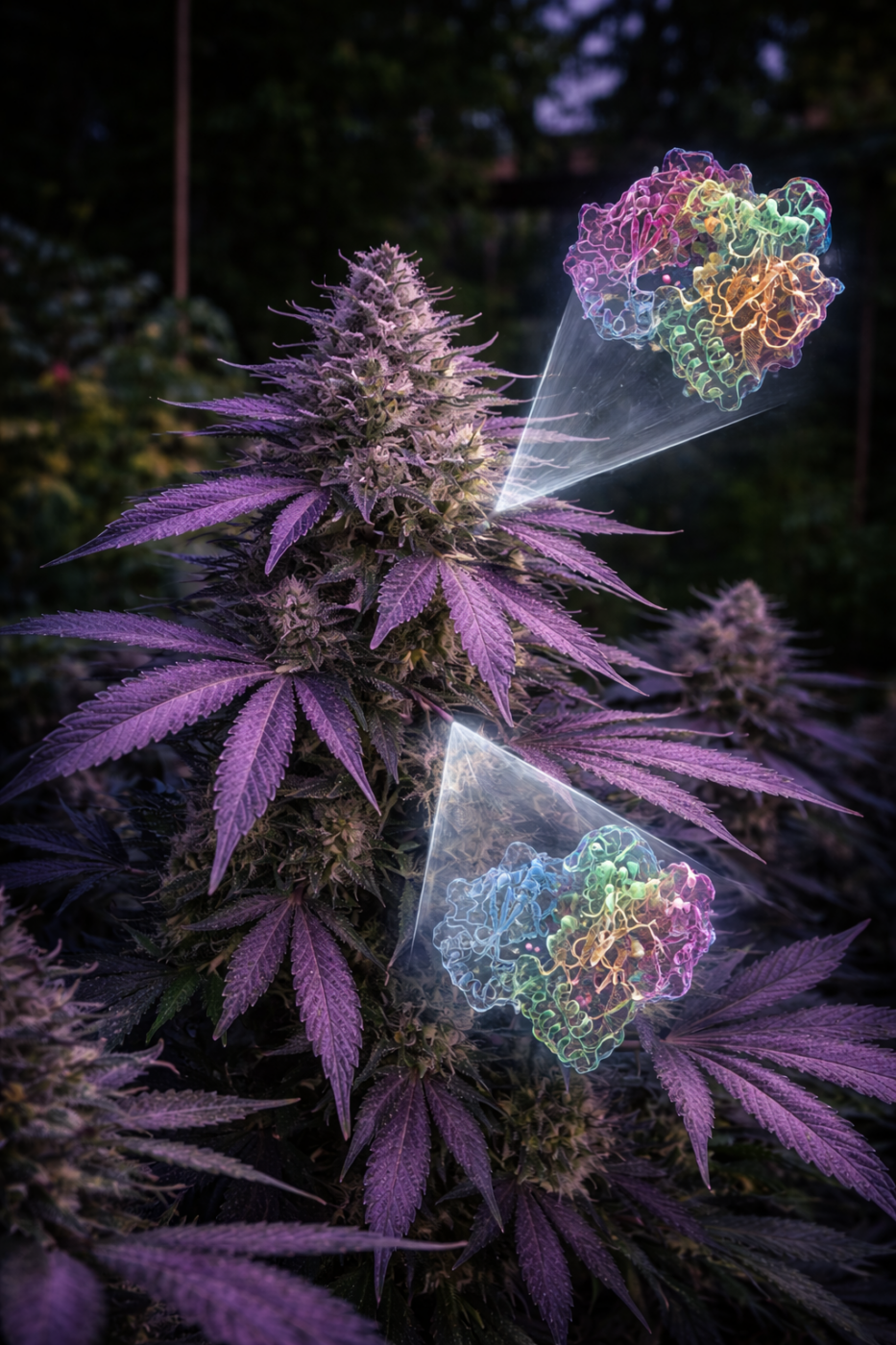
In a groundbreaking study published in Plant Biotechnology Journal, researchers at Wageningen University have accomplished what might sound like science fiction: they’ve resurrected ancient cannabis enzymes that existed over 25 million years ago, before cannabis and hops diverged into separate species (Villard et al., 2025). By bringing these ancestral proteins back to life, the team has illuminated the evolutionary pathway that gave rise to the three major cannabinoid synthases we know today—THCA synthase, CBDA synthase, and CBCA synthase.
The implications extend far beyond academic curiosity. This research not only solves long-standing mysteries about cannabinoid biosynthesis but also provides practical tools for cannabis breeders and biotechnology applications, potentially revolutionizing how we produce therapeutic cannabinoids.
The Mystery of Cannabinoid Origins
Cannabis produces over 120 different cannabinoids, but the “big three”—THC, CBD, and CBC—share a common biochemical origin. All three are synthesized from a single precursor molecule called cannabigerolic acid (CBGA) through regioselective reactions catalyzed by specialized enzymes called cannabinoid oxidocyclases (Taura et al., 1995; Taura et al., 1996; Morimoto et al., 1998). These enzymes belong to the Berberine Bridge-Like (BBL) enzyme family and perform chemically challenging oxidoreductions via a flavin adenine dinucleotide (FAD) cofactor (Daniel et al., 2017).
Previous comparative genomics work revealed that THCA synthase (THCAS), CBDA synthase (CBDAS), and CBCA synthase (CBCAS) genes arose from recent gene duplications within the Cannabis lineage, forming what researchers call a “cannabis-specific clade” (van Velzen & Schranz, 2021). Intriguingly, this clade is completely absent from hops (Humulus lupulus), cannabis’s closest relative. This raised a tantalizing question: did the ability to metabolize CBGA originate within the Cannabis lineage, or did it exist in a common ancestor before cannabis and hops split? And how did these highly specialized enzymes evolve from their ancestor?
Until now, these questions remained hypothetical. Villard and colleagues decided to test them experimentally using a powerful technique called ancestral sequence reconstruction.
Bringing Ancient Enzymes Back to Life
The researchers selected 77 BBL sequences from cannabis, hops, and a related species (Trema orientale) and constructed a Bayesian phylogenetic tree to map evolutionary relationships. From this tree, they identified three key ancestors to resurrect:
HCa – the most recent common ancestor of the cannabis-specific clade and its sister clade (present before cannabis-hops divergence)
Ca – the most recent common ancestor of all cannabis-specific cannabinoid synthases
A1A2a – the most recent common ancestor of THCAS and CBCAS
Using both Bayesian inference and Maximum Likelihood methods, the team reconstructed the most probable ancestral sequences with high confidence (average posterior probabilities of 0.94–0.96). They then synthesized these ancient genes, expressed them in yeast (Komagataella phaffii), purified the resulting enzymes, and tested whether they could metabolize CBGA.
The Smoking Gun: When Cannabinoid Production Began
The results were revelatory. When the researchers tested their resurrected enzymes, they found that HCa—the oldest ancestor predating the cannabis-hops split—could not metabolize CBGA at all, despite being properly expressed. Neither could the hop BBL enzyme they tested. This definitively confirmed that cannabinoid production emerged after the divergence from hops, somewhere along the evolutionary branch leading from HCa to Ca.
Even more fascinating was what they discovered about Ca, the ancestral cannabinoid synthase. Rather than being specialized for one cannabinoid, Ca was remarkably promiscuous, producing all three major cannabinoids: 60% THCA, 30% CBDA, and 10% CBCA. This challenges an earlier hypothesis that the first cannabinoid oxidocyclase was a CBDA synthase (Onofri et al., 2015). Instead, the ancestral enzyme was a generalist that favored THCA production but maintained the flexibility to produce multiple cannabinoids.
The more recent ancestor A1A2a showed increasing specialization toward THCA (87% THCA, 13% CBCA), while modern THCAS has become highly refined, producing 95% THCA with only 5% CBCA as a byproduct. Modern CBDAS went in a different direction—it became specialized for CBD production (89% selectivity) but at a significant cost: it’s only 12% as active as THCAS.
Molecular Detective Work: Identifying Key Mutations
To understand exactly which mutations drove this evolutionary transformation, the researchers employed an ingenious strategy: they created “hybrid” enzymes by swapping specific amino acid residues between ancestral and modern enzymes. This allowed them to test which mutations were necessary and sufficient for particular functional changes.
The Birth of Cannabinoid Production
Comparing HCa (inactive) with Ca (active), the team identified 116 amino acid mutations. They focused on two critical regions: the substrate binding region (SBR) and the FAD binding site (FBS). When they introduced just 39 SBR mutations from Ca into the HCa backbone, they created a hybrid enzyme (HCa → CaSBR) that could suddenly metabolize CBGA—producing almost pure CBCA (>99%).
Among these critical mutations were three previously identified as essential: H292 (the likely counterion to CBGA’s carboxylate group), A116 (which positions the catalytic base), and S355 (whose ancestral form inactivates modern THCAS). Structural analysis revealed that mutations like E376G and Q448T significantly widened the substrate binding cavity, creating a larger opening toward the FAD cofactor—suggesting that HCa probably metabolized a smaller substrate, and cavity expansion was essential for accommodating CBGA.
But the real breakthrough came when they added a four-amino acid insertion at positions 359–362. This insertion, part of a flexible region called the ASA-loop (active site adjacent loop), dramatically changed the enzyme’s behavior. The hybrid HCa → CaSBR_Ins showed 3.6-fold higher activity and began producing a mix of cannabinoids (56% CBCA, 28% THCA, 16% CBDA), rather than just CBCA. This tiny insertion appears to have been the evolutionary innovation that enabled cannabinoid diversification.
The Path to Specialization
To understand how Ca’s broad activity became specialized into modern CBDAS and THCAS, the researchers designed additional hybrids. Introducing just 14 SBR mutations from CBDAS into Ca created an enzyme (Ca → CBDASSBR) that reversed the THCA/CBDA production ratio, favoring CBDA (63% CBDA, 30% THCA, 7% CBCA).
Remarkably, structural modeling revealed that mutations in the ASA-loop—specifically N361D, A363D, K366N, and K343R—caused a rotation of residues 358–366. This rotation appears to result from charge-altering mutations that moved negatively charged aspartate residues (D361, D363) toward a positively charged arginine (R343), carrying neighboring residues along with them. This reconfiguration likely alters how CBGA binds and favors CBDA production over THCA.
Adding four additional FAD-binding site mutations created Ca → CBDASSBR_FAD, which produced 81% CBDA with 3.4-fold higher activity than natural CBDAS—a finding with immediate practical implications for biotechnology.
Similarly, introducing just eight SBR mutations from A1A2a into Ca created an enzyme that completely stopped producing CBDA while maintaining similar overall activity (76% THCA, 24% CBCA). Two mutations in particular—G379T and I446T—appear to be the key changes that prevent CBDA production.
The ASA-Loop Revolution
One of the most significant discoveries in this work is the central role of the ASA-loop—a flexible, looped region that has received little attention in previous studies (Villard et al., 2023). Out of 26 residues in this loop, 21 evolved from HCa to modern enzymes. The four-residue insertion from HCa to Ca, the charge-driven rotation from Ca to CBDAS, and the G379T mutation from Ca to THCAS all occur within this region.
This suggests that recent evolution of the ASA-loop was critical for the evolution of cannabinoid oxidocyclase substrate and product selectivity. Meanwhile, residues essential for general BBL enzyme function—like the catalytic base and covalent FAD-binding residues—remained strictly conserved from HCa through all modern enzymes, suggesting that HCa and the hop BBL enzyme are functional, even though their natural substrates remain unknown.
From Ancient Proteins to Modern Applications
While resurrecting ancient enzymes might seem like pure academic pursuit, this research has immediate practical value for both cannabis breeding and biotechnology.
Superior Enzymes for Biotechnology
Currently, medicinal cannabinoids are predominantly produced through cannabis cultivation, but biotechnological production in microorganisms represents a promising alternative with better scalability and consistency (Adhikary et al., 2021). However, this approach has been hampered by the low activity and expression levels of CBDAS and CBCAS (Carvalho et al., 2017; Luo et al., 2019; Schmidt et al., 2024).
The ancestral enzymes proved to be game-changers. Compared to modern THCAS, expression levels were 3–4 times higher for A1A2a, 1.5–3 times higher for Ca, and 2–3 times higher for HCa. The hybrid enzymes maintained these high expression levels.
More impressively, Ca → CBDASSBR_FAD produced 3.1-fold more CBDA than natural CBDAS while expressing 2–3 times better. For CBCA production, HCa → CaSBR exhibited almost perfect selectivity (>99%) with 3–4 times higher expression than THCAS. These engineered ancestors could help overcome the classic bottleneck of cannabinoid production in microorganisms.
Novel Chemotypes for Cannabis Breeding
For cannabis breeders, these ancestral and hybrid enzymes open new possibilities. CBCA is typically present in low concentrations in most cannabis cultivars (Wishart et al., 2024), yet it shows promising therapeutic potential for neuroprotection and inflammation modulation (Stone et al., 2020; Cammà et al., 2025). The HCa → CaSBR enzyme, with its near-perfect CBCA selectivity, could be introduced into cannabis plants to generate novel CBCA-dominant cultivars—a chemotype difficult to achieve through traditional breeding.
Additionally, the promiscuous Ca ancestor or other hybrid enzymes could create unique cannabinoid ratios unavailable in nature. For hash producers seeking specific terpene-cannabinoid profiles, or medical researchers exploring cannabinoid synergies, these tools offer unprecedented control over plant biochemistry.
Ancestral Proteins as Engineering Platforms
The researchers discovered an important principle: ancestral enzymes make better engineering platforms than modern ones. When they tried to engineer modern THCAS to produce CBDA by introducing the mutations that worked in ancestral backgrounds, the result was complete failure—the enzyme couldn’t metabolize CBGA at all.
This suggests that THCAS has become so structurally specialized for THCA production that its active site is now locked into a rigid configuration. Ancestral enzymes like Ca retain enough structural flexibility to be modified successfully, making them ideal starting points for protein engineering efforts.
Broader Evolutionary Insights
This research also illuminates broader patterns in enzyme evolution. The data suggest that cannabinoid production has evolved independently in distantly related plant families. BBL enzymes from Rhododendron dauricum (Ericaceae) produce daurichromenic acid—a farnesyl analog of CBCA (Taura et al., 2014)—and certain bacterial BBL enzymes produce CBC (Love et al., 2024). This suggests that BBL enzymes may be biochemically predisposed toward CBC(A) cyclization.
The researchers hypothesize that CBCA may have been the original product of early cannabinoid oxidocyclases. CBCA is produced at neutral pH and could have been physiologically relevant before cannabinoid oxidocyclases were secreted into acidic trichomes. The four-residue insertion in the ASA-loop then enabled product diversification into THCA and CBDA, with subsequent gene duplication and selection driving specialization.
Interestingly, the evolution toward THCA production correlated with increased enzyme activity, while evolution toward CBDA production correlated with decreased activity. This pattern suggests either that mutations favoring CBDA production inherently compromise catalytic efficiency, or that ancestral cannabis plants with less active CBDA synthases had some selective advantage—perhaps producing moderate CBD levels was more beneficial than high levels.
Looking Forward
By resurrecting ancient enzymes that existed before cannabis and hops diverged, Villard and colleagues have provided the first experimental confirmation of how, when, and why cannabinoid biosynthesis evolved. Their work demonstrates that ancestral sequence reconstruction is not just a tool for understanding the past—it’s a powerful approach for engineering the future.
The ancestral and hybrid enzymes they’ve created offer superior expression, activity, and engineering flexibility compared to modern cannabinoid synthases. These tools could accelerate biotechnological cannabinoid production, enable new cannabis chemotypes for medical research and breeding, and provide a platform for designing entirely novel cannabinoids.
Perhaps most remarkably, this study identified 47 previously untested amino acid residues that influence cannabinoid synthase function—a treasure trove of targets for future site-directed mutagenesis experiments. As we continue to unravel the molecular mechanisms controlling cannabinoid biosynthesis, we move closer to rational design of enzymes tailored for specific therapeutic applications.
The past, it turns out, holds the key to the future of cannabis biotechnology.
References
Adhikary, D., Kulkarni, J., Bhatia, A., & Khatri-Chhetri, U. (2021). Metabolic engineering for enhanced cannabinoid production in Cannabis sativa. Journal of Plant Biochemistry and Biotechnology, 30, 783–795.
Cammà, C., Carrieri, A., Cellamare, S., & Altomare, C.D. (2025). Cannabichromene: A journey through its neuroprotective and anti-inflammatory properties. Current Medicinal Chemistry.
Carvalho, Â., Hansen, E.H., Kayser, O., Carlsen, S., & Stehle, F. (2017). Designing microorganisms for heterologous biosynthesis of cannabinoids. FEMS Yeast Research, 17(4).
Daniel, B., Konrad, B., Toplak, M., Lahham, M., Messenlehner, J., Winkler, A., & Macheroux, P. (2017). The family of berberine bridge enzyme-like enzymes: A treasure-trove of oxidative reactions. Archives of Biochemistry and Biophysics, 632, 88–103.
Love, A.C., Nielsen, K.F., Adams, N.B.P., Popat, R., & Harrison, F. (2024). A bacterial berberine bridge enzyme produces cannabichromene. ACS Synthetic Biology.
Luo, X., Reiter, M.A., d’Espaux, L., Wong, J., Denby, C.M., Lechner, A., Zhang, Y., Grzybowski, A.T., Harth, S., Lin, W., Lee, H., Yu, C., Shin, J., Deng, K., Benites, V.T., Wang, G., Baidoo, E.E.K., Chen, Y., Eng, I., Katz, L., Keasling, J.D. (2019). Complete biosynthesis of cannabinoids and their unnatural analogues in yeast. Nature, 567(7746), 123–126.
Morimoto, S., Komatsu, K., Taura, F., & Shoyama, Y. (1998). Purification and characterization of cannabichromenic acid synthase from Cannabis sativa. Phytochemistry, 49(6), 1525–1529.
Onofri, C., de Meijer, E.P., & Mandolino, G. (2015). Sequence heterogeneity of cannabidiolic- and tetrahydrocannabinolic acid-synthase in Cannabis sativa L. and its relationship with chemical phenotype. Phytochemistry, 116, 57–68.
Schmidt, M., Contesini, F.J., & Angelov, A. (2024). Biosynthesis of cannabinoids: Advances and opportunities. Biotechnology Advances, 76, 108409.
Stone, N.L., Murphy, A.J., England, T.J., & O’Sullivan, S.E. (2020). A systematic review of minor phytocannabinoids with promising neuroprotective potential. British Journal of Pharmacology, 177(19), 4330–4352.
Taura, F., Morimoto, S., & Shoyama, Y. (1995). Cannabinerolic acid, a cannabinoid from Cannabis sativa. Phytochemistry, 39(2), 457–458.
Taura, F., Morimoto, S., Shoyama, Y., & Mechoulam, R. (1996). First direct evidence for the mechanism of Δ1-tetrahydrocannabinolic acid biosynthesis. Journal of the American Chemical Society, 118(7), 1581–1582.
Taura, F., Tanaka, S., Taguchi, C., Fukamizu, T., Tanaka, H., Shoyama, Y., & Morimoto, S. (2014). Characterization of olivetol synthase, a polyketide synthase putatively involved in cannabinoid biosynthetic pathway. FEBS Letters, 583(12), 2061–2066.
van Velzen, R., & Schranz, M.E. (2021). Origin and evolution of the cannabinoid oxidocyclase gene family. Genome Biology and Evolution, 13(8), evab130.
Villard, C., Baser, I., van de Peppel, A.C., Cankar, K., Schranz, M.E., & van Velzen, R. (2023). Ancestral sequence reconstruction reveals the structural evolution of cannabinoid synthases. Journal of Biological Chemistry, 299(5), 104629.
Villard, C., Baser, I., van de Peppel, A.C., Cankar, K., Schranz, M.E., & van Velzen, R. (2025). Resurrected ancestral cannabis enzymes unveil the origin and functional evolution of cannabinoid synthases. Plant Biotechnology Journal, https://doi.org/10.1111/pbi.70475
Wishart, D.S., Cheng, L.L., Copié, V., Edison, A.S., Eghbalnia, H.R., Hoch, J.C., Gouveia, G.J., Pathmasiri, W., Powers, R., Schock, T.B., Sumner, L.W., & Vu, H. (2024). NMR and metabolomics—A roadmap for the future. Metabolites, 14(1), 40.