

Executive Summary
This market analysis reviews Data Bridge Market Research’s comprehensive report on the global cannabis seeds market. The report presents findings covering market size projections, segmentation analysis, regional dynamics, and competitive landscape through 2032. Below is a structured assessment of the report’s key data points, methodology, and strategic insights.
Market Size and Growth Trajectory
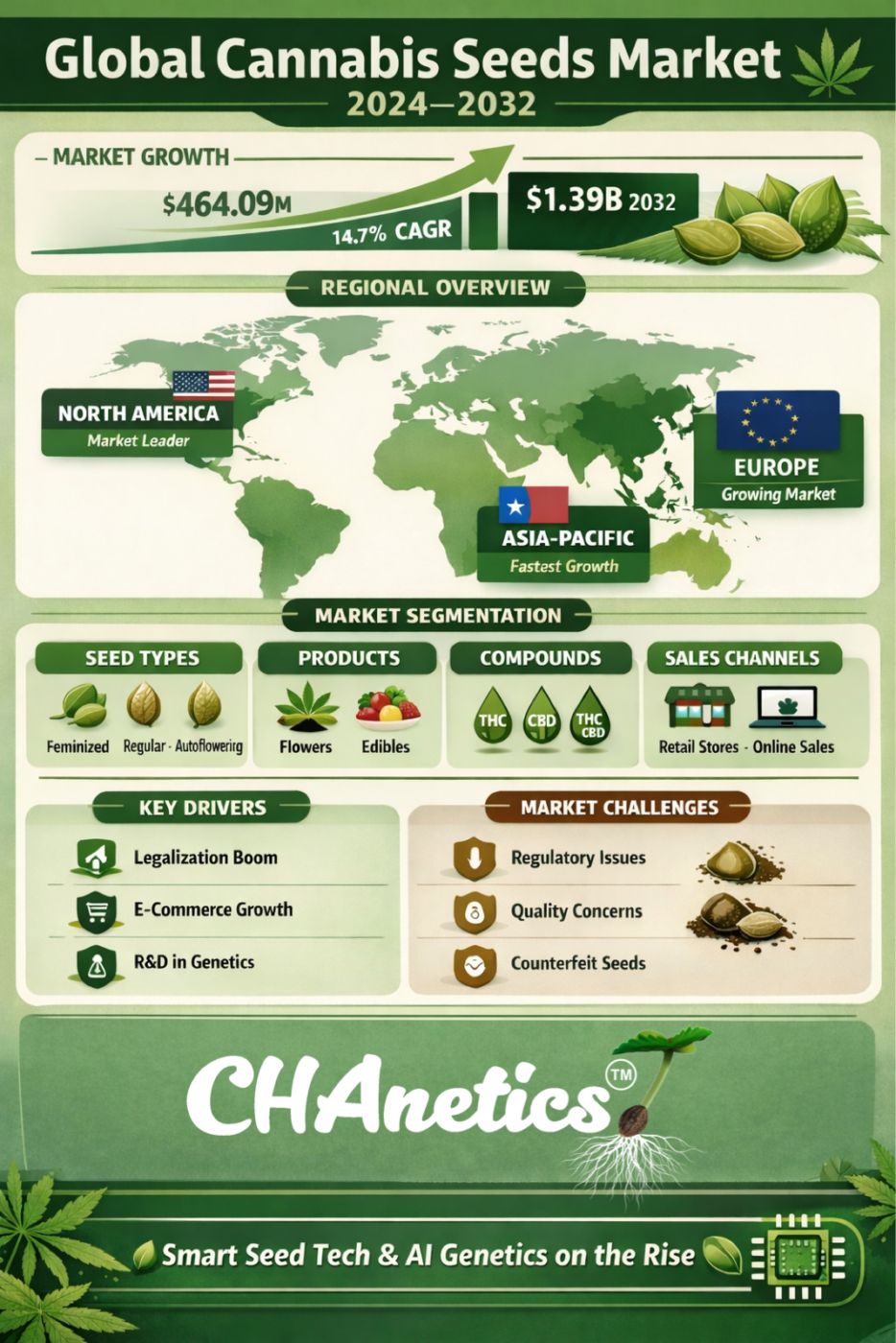
According to the report, the global cannabis seeds market was valued at USD 464.09 million in 2024 and is projected to reach USD 1,390.33 million by 2032 (Data Bridge Market Research), representing a compound annual growth rate of 14.70% during the forecast period (Data Bridge Market Research). This nearly three-fold expansion reflects accelerating demand driven by both regulatory liberalization and evolving consumer preferences.
The projected growth rate positions cannabis seeds as a high-momentum segment within the broader agricultural biotechnology sector. The market’s expansion appears closely tied to macroeconomic shifts in cannabis legalization and the maturation of both medical and recreational cannabis industries globally.
Key Market Drivers
The report identifies several primary growth catalysts:
Regulatory Liberalization: Legalization of cannabis for medical and recreational use across multiple regions is the primary growth driver (Data Bridge Market Research). The report specifically cites Germany’s March 2024 legalization of recreational cannabis as spurring immediate demand surges from domestic and international seed suppliers.
Medical Cannabis Adoption: Rising awareness of cannabinoids’ therapeutic potential, particularly for pain management, anxiety, and neurological conditions, is expanding the medical cultivation segment and driving demand for CBD-dominant and specialized medicinal strains.
E-Commerce Expansion: The proliferation of online seed banks and global distribution channels has democratized access to premium genetics, enabling both commercial operations and home cultivators to source high-quality seeds regardless of geographic location.
Genetic Innovation: Ongoing research and development in seed genetics, including feminized varieties and autoflowering strains, is creating products that deliver higher yields, greater consistency, and improved cultivation ease. These factors attract both experienced and novice growers.
Market Segmentation Analysis
By Seed Type: The feminized seeds segment dominated the market with 48.9% revenue share in 2024 (Data Bridge Market Research), attributed to their ability to guarantee female plants, which are the primary source of cannabinoid-rich flowers. However, autoflowering seeds are anticipated to witness the fastest growth rate through 2032 (Data Bridge Market Research), driven by shorter cultivation cycles and greater ease of use, particularly appealing to residential growers and those with limited space.
By Product Type: Flowers held the largest revenue share at 42.6% in 2024 (Data Bridge Market Research), reflecting their dominance in traditional consumption methods. Notably, the edibles segment is expected to achieve the fastest growth (Data Bridge Market Research), fueled by demand for discreet, smoke-free consumption formats and innovations in infused food products.
By Strain: Hybrid strains captured 44.3% of market revenue in 2024 (Data Bridge Market Research), valued for their ability to combine desirable traits from both indica and sativa varieties. The indica segment is projected to grow most rapidly due to its therapeutic applications in pain relief and sleep disorders.
By Compound: THC-dominant seeds accounted for 55.1% of market share in 2024 (Data Bridge Market Research), driven primarily by recreational demand. However, CBD-dominant seeds are forecasted to register the fastest growth (Data Bridge Market Research), reflecting surging interest in non-intoxicating therapeutic products.
By Distribution Channel: Store-based retailing held 57.8% revenue share in 2024 (Data Bridge Market Research), maintained by regulatory requirements and consumer preference for in-person consultation. Nevertheless, online and e-commerce channels are expected to grow fastest (Data Bridge Market Research), supported by digital adoption and regulatory evolution permitting online seed sales.
Geographic Market Dynamics
North America: North America dominated with 44.56% revenue share in 2024 (Data Bridge Market Research), driven by widespread legalization across U.S. states and Canadian provinces. The region benefits from mature infrastructure, robust research activity, and strong consumer adoption of both medical and recreational cannabis. The U.S. captured the largest revenue share within North America in 2024 (Data Bridge Market Research), fueled by expanding state-level legalization and a thriving market for customized strains.
Europe: The report indicates substantial growth potential in Europe, with Germany emerging as a particularly dynamic market following its 2024 recreational legalization. The U.K. market is anticipated to grow at a noteworthy rate (Data Bridge Market Research), despite recreational restrictions, due to medical cannabis adoption and CBD-focused cultivation. Germany is expected to expand considerably during the forecast period (Data Bridge Market Research), supported by government-led legalization initiatives and a large medical patient population.
Asia-Pacific: Asia-Pacific is poised to grow at the fastest rate of 11.69% from 2025 to 2032 (Data Bridge Market Research), driven by progressive legalization in countries including Thailand, Australia, and India. China accounted for the largest market revenue share in Asia-Pacific in 2024 (Data Bridge Market Research), leveraging its dominance in industrial hemp cultivation and strong agricultural biotechnology capabilities.
Competitive Landscape
The report identifies 16 major players operating in the global cannabis seeds market, with a notable concentration of leading companies based in the Netherlands and Spain, regions with established expertise in cannabis genetics and seed breeding. Key market participants include T.H.Seeds, Royal Queen Seeds, Dutch Passion, Sensi Seeds, and DNA Genetics.
Recent strategic developments highlight the industry’s innovation focus. Royal Queen Seeds’ January 2023 launch of true F1 cannabis hybrids represents a significant advancement in genetic standardization, offering improved uniformity and yield consistency for commercial cultivation. Similarly, CBD Seed Europe’s September 2022 registration of high-CBD genotypes demonstrates ongoing efforts to develop specialized medical strains with enhanced cannabinoid profiles.
Emerging Trends
The report identifies personalized cultivation supported by artificial intelligence and automated growing systems as a transformative trend. AI-driven platforms now assist in strain selection based on environmental parameters, while smart cultivation systems with connected sensors enable real-time monitoring and automated adjustments throughout the growth cycle. This technological integration is democratizing high-quality cannabis production, making sophisticated cultivation techniques accessible to novice growers.
Market Challenges
Regulatory Inconsistency: Despite growing legalization, significant jurisdictional variations in cannabis laws continue to constrain cross-border seed trade and create market fragmentation. Countries in Asia and parts of Europe maintain strict prohibitions, limiting market access and complicating international expansion strategies.
Quality Standardization: The absence of uniform seed certification standards and strain labeling protocols creates information asymmetries, particularly in online markets. This variability can result in inconsistent crop outcomes and erode brand trust.
Environmental Sensitivity: Cannabis cultivation success remains highly dependent on climate conditions, presenting challenges for growers in non-optimal regions even when using high-quality seeds.
Report Methodology Assessment
The report employs data triangulation methodology combining primary research, secondary data analysis, and expert validation. The research framework includes vendor positioning analysis, pricing evaluation, market share assessment, and value chain examination. The study encompasses 350 pages with 220 tables and 60 figures, suggesting comprehensive data coverage.
However, as with all market forecasts, projections should be interpreted with appropriate caution regarding regulatory uncertainties, competitive dynamics, and macroeconomic variables that could impact actual outcomes.
Strategic Implications
The cannabis seeds market presents significant growth opportunities, particularly for companies positioned to capitalize on geographic expansion into emerging markets, especially Asia-Pacific territories experiencing regulatory reform, product innovation focused on specialized genetics including high-CBD varieties and climate-adapted strains, technology integration combining advanced breeding techniques with digital cultivation platforms, e-commerce optimization to capture the rapidly growing online distribution channel, and medical market penetration as clinical evidence supporting therapeutic applications continues to expand.
For industry participants, the market’s projected trajectory suggests favorable conditions for investment in research, production capacity, and distribution infrastructure, particularly in jurisdictions with supportive regulatory frameworks.
Conclusion
Data Bridge Market Research’s report presents a comprehensive analysis of a dynamic market experiencing significant transformation. The projected 14.70% CAGR through 2032 reflects fundamental shifts in regulatory environments, consumer attitudes, and cultivation practices. While challenges around standardization and regulatory fragmentation persist, the overall market trajectory appears robust, supported by growing medical acceptance, recreational normalization, and continuous genetic innovation. Stakeholders should monitor regulatory developments closely, as policy changes represent both the primary growth catalyst and the most significant uncertainty factor influencing market outcomes.